Menu
Research
My research examines how food institutions and everyday practices shape our relationships with places and with one another.
I bring philosophical work on classification and ethical formation into conversation with interdisciplinary food studies, and I am now extending my dissertation into work on institutional responsibility and on how ordinary practices can direct attention and shape a meaningful life.
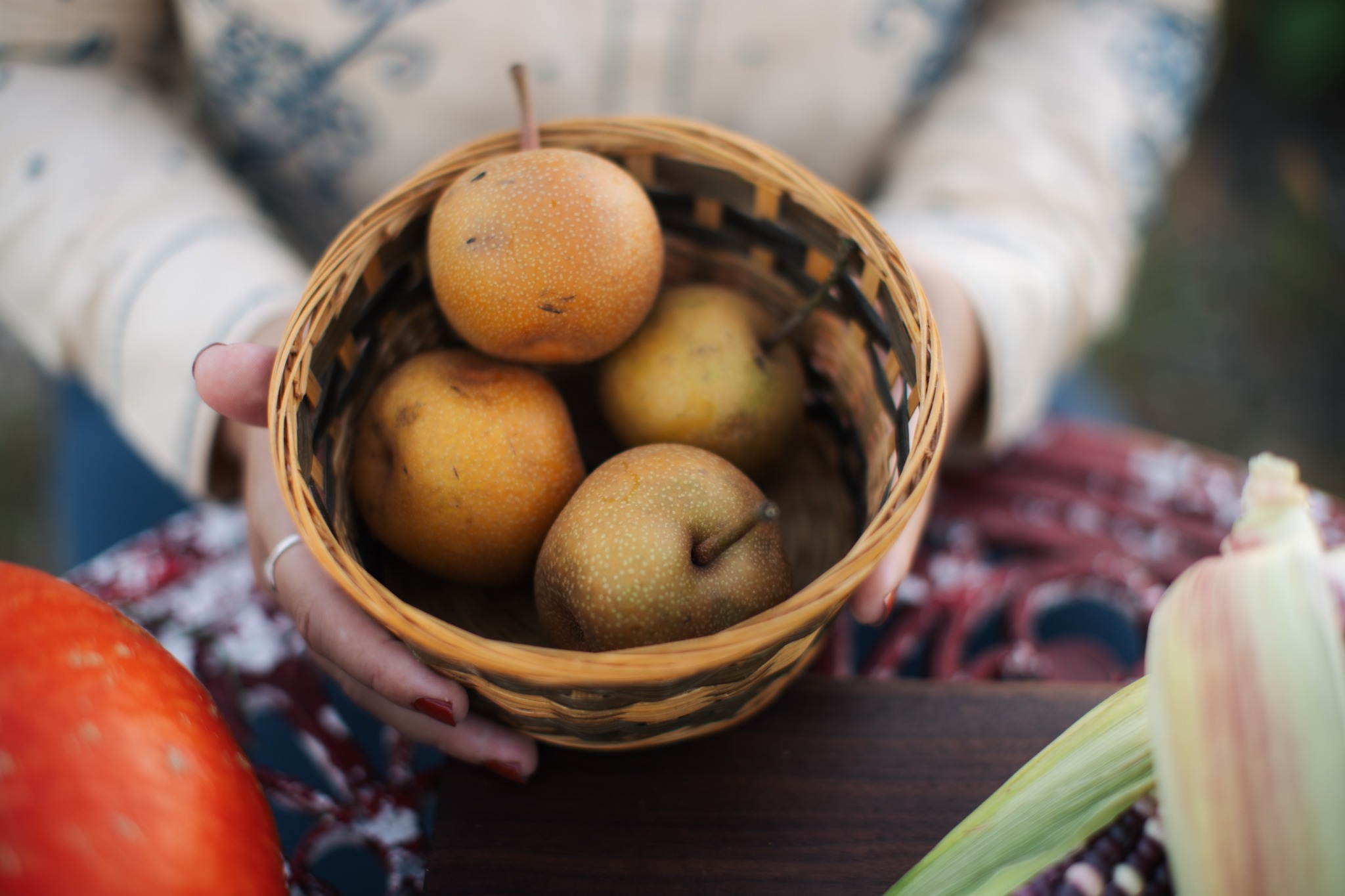
Photo: Liz Barney
Current Research
I am developing the dissertation chapters for publication, arguing that institutions such as farmers markets help determine which relationships make food count as local in a particular setting, and that belonging to a particular kind of food requires both material suitability and an appropriate connection to the shared practice that sustains it.
In “’We Are What We Eat’: Slow Food and Ethical Self-Formation,” now under review at Gastronomica, I argue that food practices can be ethically formative without serving as evidence of an eater’s moral worth, and that while slow-food practices can cultivate patience, pleasure, and care, what they offer depends on whether people can fit them into lives they can actually live.
In my most recent project, “Cultivating Attention: Food Practices and Spiritual Formation,” I ask how seasonal and place-based practices might teach people to notice their dependence on a place and on the lives around them, and I consider when that attention counts as ethical or spiritual formation.
We Are What We Eat: Alice Waters, Slow Food, and Moral Agency
In March 2026 I gave the inaugural Culinary Mind/Gastronomica Lecture in the Philosophy of Food, which was a version of Chapter 3 of my dissertation and is recorded here:
Dissertation
Cultivating a Fruitful Metaphysics of Food · University of Michigan, 2026
Read the dissertation abstract
This dissertation develops a social metaphysics of food centered around how food categories become determinate through practices that organize material things into socially meaningful roles. Food has to be edible, but material availability does not by itself determine what counts as food, what kind of food something is, or what ethical significance food practices have. Those questions are settled in the space between bodily need, material possibility, and organized human life. Methodologically, this means staying close to actual food practices. Drawing on social metaphysics alongside philosophy of food, food studies, archival and institutional materials, and situated participation, I use particular cases to illuminate the metaphysical questions.
Chapter 1 argues that local food is best understood as a food-related status whose content becomes determinate within particular institutions and communities. Other philosophers of food have shown that localness is plural: it can depend on nearness to a place, on relations between producers and consumers, or on a food’s connection to the history and identity of a place. My contribution is to ask how one of these dimensions becomes the one that matters in a particular setting. I argue that institutions such as farmers markets, farm stops, co-ops, and grocery retailers confer local-food status by making some relations among food, place, producers, and consumers count as significant for localness. They do not create localness from nothing, and they do not make food local by fiat. But they can make localness determinate enough, in determinate contexts, to guide classification, governance, and behavior.
Chapter 2 argues that food-kind membership is materially constrained and practice-dependent. The central case is Ustilago maydis, a fungus that infects ears of sweet corn. In Mexican culinary contexts, it is often huitlacoche: something harvested, prepared, sold, and eaten as food. In many dominant U.S. agricultural contexts, the same fungus is treated as corn smut: crop disease, damage, and economic loss. This case shows why biology, individual uptake, and authority cannot each settle foodhood on their own. Biology alone cannot explain the difference between huitlacoche and corn smut; individual uptake cannot explain why cooking and eating Ustilago maydis does not automatically make it huitlacoche; and authority can be late, partial, or distortive. I argue that a token belongs to a food kind when it is materially suitable and appropriately connected to a practice through which that kind is stabilized.
Chapter 3 argues that food practices can be ethically formative without serving as evidence of an eater’s moral worth. I develop this argument through a response to Alice Waters’s We Are What We Eat: A Slow Food Manifesto. I argue that Waters is right that eating can shape attention, pleasure, care, and relation to place. But she sometimes moves too quickly from the thought that food practices shape people to the thought that eating practices reveal what kind of people we are. I resist that move both because people eat under conditions they do not fully choose, and because food does not have to be the place where everyone exercises moral agency most fully. Slow food can be valuable as one way ordinary practices can cultivate more attentive, pleasurable, relational, and responsible relationships to the earth and other humans, but it should not become a standard for ranking eaters.
Taken together, the chapters show how food statuses, food kinds, and food practices become determinate without being reducible either to natural properties or to social declaration. For philosophy of food, the dissertation brings metaphysical questions to the center of food ethics and politics. For social metaphysics, food is a useful site because it is never only material and never only social: it shows how bodies, practices, and institutions come together in ordinary categories that are easy to take for granted. Altogether, the dissertation aims to show the importance of taking real-world practices seriously as we engage in philosophical projects about the social world.

